
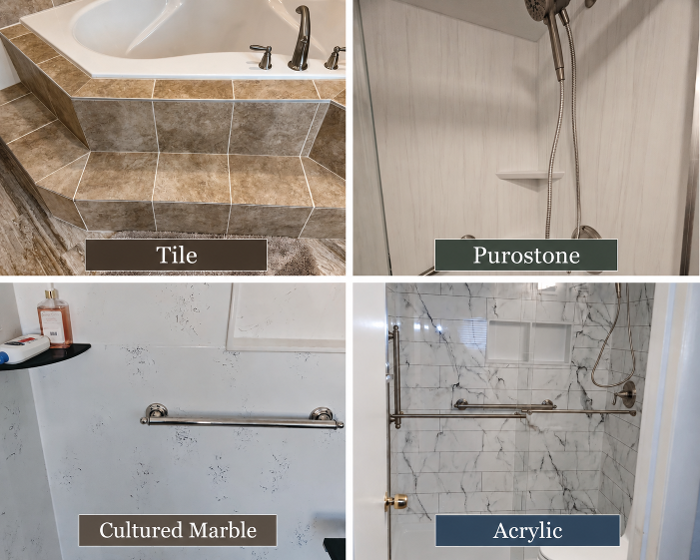
Choosing the Right Shower Wall Material: Acrylic vs. Purostone vs. Cultured Marble vs. Tile
When planning a new shower, one of the biggest decisions you'll make is what material to use for the walls. While color and pattern are important, there's much more to consider. Maintenance, durability, installation time, available designs, and budget can all affect which shower wall system makes the most sense for your home.
At GC Makeovers, we work with several shower wall options because there isn't one material that's right for every homeowner. Acrylic, Purostone, cultured marble, and traditional tile each offer different advantages. Understanding those differences can help you choose a shower you'll be happy with for years to come.
Acrylic Shower Walls
Acrylic remains a popular choice for homeowners who want a clean, attractive shower that's easy to maintain. Modern acrylic shower systems are available in far more colors, patterns, and textures than many homeowners expect, including designs that can create the appearance of stone or tile without traditional grout lines.
One of acrylic's biggest advantages is low maintenance. The smooth, nonporous surface is easy to clean and doesn't require the grout maintenance associated with a traditional tile shower. Quality acrylic systems are also designed specifically for wet environments, making them a practical choice for bathrooms that see daily use.
Acrylic can be especially well suited for one-day shower replacements and tub-to-shower conversions, where homeowners want to dramatically update their bathroom while minimizing construction time.
Acrylic may be a good choice if you want: easy maintenance, a wide variety of designs, faster installation, durability, and a more budget-conscious alternative to some premium materials.
Purostone Shower Walls
Purostone provides another option for homeowners who want the appearance and character of natural stone without some of the maintenance associated with traditional stone and tile installations.
Its larger wall panels can create a more seamless appearance with fewer joints, giving the shower a clean, upscale look. Depending on the selected design, Purostone can complement bathrooms ranging from contemporary to more traditional styles.
For homeowners who want their shower to have a more substantial, stone-inspired appearance while still benefiting from a modern shower-wall system, Purostone can offer an attractive middle ground.
Purostone may be a good choice if you want: a premium stone-inspired appearance, fewer seams and grout lines, easier maintenance, distinctive patterns, and a shower that feels more customized.
Cultured Marble Shower Walls
Cultured marble has been used in bathrooms for decades, and today's options can provide a polished, substantial appearance without requiring individual pieces of natural stone.
The material is manufactured using stone-derived materials combined with resins and finished with a protective surface. Because cultured marble can be produced in larger sections, it allows homeowners to achieve a stone-like shower with considerably fewer grout lines than traditional tile.
It can work particularly well for homeowners who appreciate a classic or elegant bathroom design and want larger wall surfaces with relatively straightforward maintenance.
Cultured marble may be a good choice if you want: a solid and substantial feel, classic styling, large wall panels, fewer grout joints, and the appearance of stone without a traditional tile installation.
Tile Showers
For homeowners who want the greatest degree of design freedom, traditional tile remains difficult to beat. Tile offers an enormous range of sizes, shapes, materials, colors, patterns, layouts, niches, borders, and decorative details.
That flexibility also comes with additional considerations.
A properly constructed tile shower involves much more than attaching tile to a wall. The underlying shower system must be correctly prepared and waterproofed before the finished tile is installed. Cutting, setting, spacing, grouting, and finishing individual tiles also makes the installation considerably more labor-intensive than installing many panel-style shower systems.
This is one of the primary reasons custom tile showers generally require more installation time and can cost more than acrylic or other shower-wall systems.
Tile also introduces grout lines, which may require more cleaning and maintenance over the life of the shower.
For the homeowner who values customization and craftsmanship, however, those trade-offs may be worthwhile.
Tile may be a good choice if you want: maximum design flexibility, custom patterns and layouts, specialty niches or accents, a traditional handcrafted appearance, and are comfortable with additional installation time and maintenance.
So Which Shower Material Is Best?
There really isn't one answer.
A homeowner who prioritizes easy cleaning and a faster remodel may prefer acrylic. Someone looking for a more stone-inspired appearance without traditional tile construction may gravitate toward Purostone. A homeowner who likes the substantial appearance of larger stone-like panels might prefer cultured marble, while someone who wants nearly unlimited design possibilities may decide that tile is worth the additional labor and maintenance.
The better question isn't "Which shower material is best?"
It's "Which shower material is best for the way I want to use and maintain my bathroom?"
Look Beyond the Surface
Whatever material you choose, the finished walls are only part of a successful shower remodel.
What's behind them matters too.
At GC Makeovers, our shower remodeling process begins by removing the existing shower or tub area so the underlying space can be evaluated before the new system is installed. This provides an opportunity to identify conditions that may need attention rather than simply covering the existing shower with a new surface.
A beautiful shower should look good on installation day-but the materials, preparation, waterproofing, and workmanship behind it are what help it perform for years afterward.
Planning a Shower Remodel?
Before choosing a shower based solely on a photograph or sample, consider how you actually use your bathroom. Think about how much maintenance you're comfortable with, the look you're trying to achieve, whether accessibility features may be important now or in the future, your remodeling timeline, and your overall budget.
Seeing the different materials and finishes in person can also make the decision much easier.
GC Makeovers can help homeowners compare shower wall materials, colors, fixtures, glass, seating, shelving, grab bars, and other options during the design process so the finished shower is built around both the home and the people who use it.